
Case Study: Improving Electrode Processing Quality for Laminated Cell Cycling Test Samples
This inquiry came from a battery manufacturer outside Japan that has developed its own next-generation battery technology and announced plans for mass production. The company was facing challenges related to insufficient processing quality of the electrodes used in laminated cell samples for cycling tests.
We were consulted at a stage when the company had already completed fundamental battery performance evaluations using coin cells and was preparing for cycling tests with laminated cells that more closely represented its intended commercial products.
To prepare the electrodes for its laminated cell samples, the company had been using steel rule dies because of their low cost and simplicity. However, it was struggling to eliminate issues such as burr formation on the current collector foil, as well as delamination and collapse of the active material layer during the cutting process.
Summary:
Consistently produce high-quality laminated cell samples without compromising battery performance!
Customer challenges
Advantages of steel rule dies and ideal applications for their use
Steel rule dies enable cutting edges to be freely shaped into virtually any contour by bending thin steel blades similar to razor blades. Their simplicity, user-friendly operation, and cost-effectiveness have made them a widely adopted solution for processing larger components, including electrodes for laminated cells.
Steel rule dies are a cost-effective and rapid solution for prototyping batteries in a variety of sizes, particularly when determining the final shape and dimensions of future samples. However, they are not ideal for battery prototyping applications that require consistently high-quality samples to obtain accurate and reliable performance data.
Inherent causes of quality degradation in cutting with steel rule dies
For a steel rule die, cutting is performed by pressing a single band-shaped blade, bent into the desired cutting shape, down onto the material against a cutting board, thereby severing the material. In practice, however, it is difficult to manufacture the entire blade so that its cutting edge is perfectly level around the full perimeter, or to ensure that the entire blade contacts the cutting board with completely uniform pressure. As a result, the cutting process is typically carried out with a cushioning sheet or similar material placed beneath the workpiece.
To provide sufficient durability for repeated use as a punching tool, a steel rule die must have a certain blade thickness. At the same time, in order to bring the die down to bottom dead center and completely sever the material into the desired shape, the tip of the blade must be ground to a sharp cutting edge. The cushioning sheet mentioned above also serves to protect this blade edge from damage during the cutting process.
Therefore, the cross-sectional profile of a steel rule die is typically V-shaped. While it is possible to adopt a blade geometry that approaches a single-bevel edge, with the cutting angle applied primarily to one side of the blade, there are practical limitations due to strength and durability requirements.
When a material is cut with a steel rule die, the active material layer tends to chip or break away from the cut edge. This occurs because the active material layer is dragged downward while remaining in contact with the sloped surfaces of the V-shaped blade during the cutting process.

Chipping and collapse of the active material layer can be observed along the cut edge. At the corner, the current collector foil is dragged downward in the cutting direction, causing sagging.
As the steel rule die penetrates the material and reaches the cushioning sheet layer, the current collector foil is simultaneously forced downward in the cutting direction. A steel rule die operates by continuing this downward motion to bottom dead center, ultimately separating the material through a tearing mechanism.
Consequently, downward burrs are formed on the current collector foil along the cut edge. Furthermore, when cutting rectangular geometries, such as laminated cell electrodes, delamination between the active material layer and the current collector foil is particularly likely to occur at the corners.
Laminated cell electrode samples require a dedicated tool.
Our customer clearly understood the quality limitations of processing with a steel rule die. To reliably meet their stringent quality standards, including no cracks, collapse, or delamination of the active material layer and burrs on the current collector foil below the allowable height, they turned to us for a high-precision punching die as a dedicated solution.
In addition, their cell development schedule called for more frequent cycling tests and a significant increase in the number of samples to be prepared. While reliably meeting the required quality standards remained the top priority, they also needed to streamline and accelerate the entire workflow, from sample preparation through measurement and evaluation.
Our proposed solution
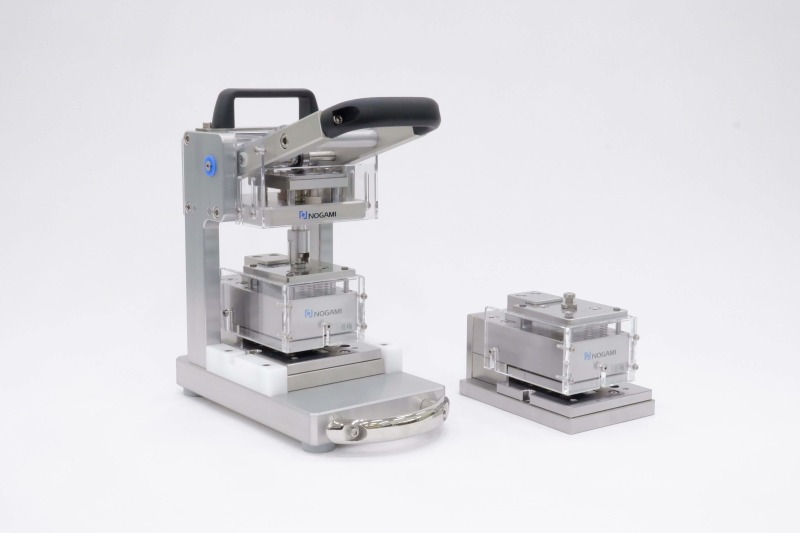
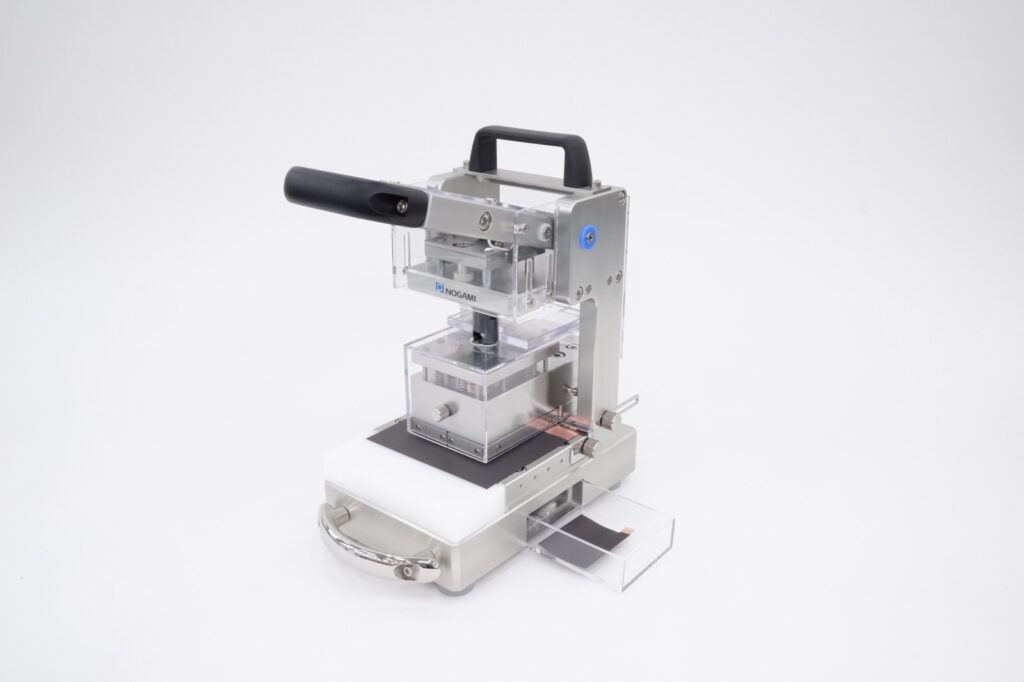
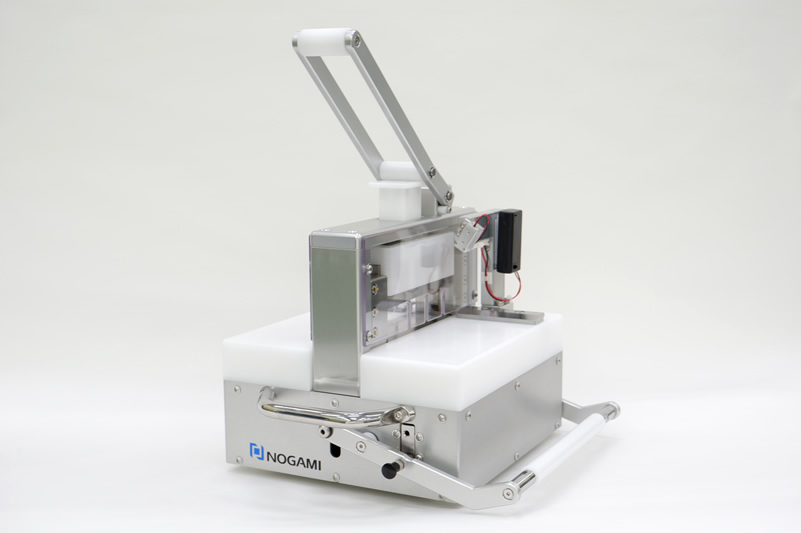
Results of adopting the Clean Press
Cut edge quality far exceeding expectations
After reviewing the test results on their own material, the customer commented, “NOGAMI’s tool fully meets our quality requirements, addressing all of our concerns, including collapse and delamination of the active material layer and burrs on the current collector foil.”

(Corner of the active material layer)
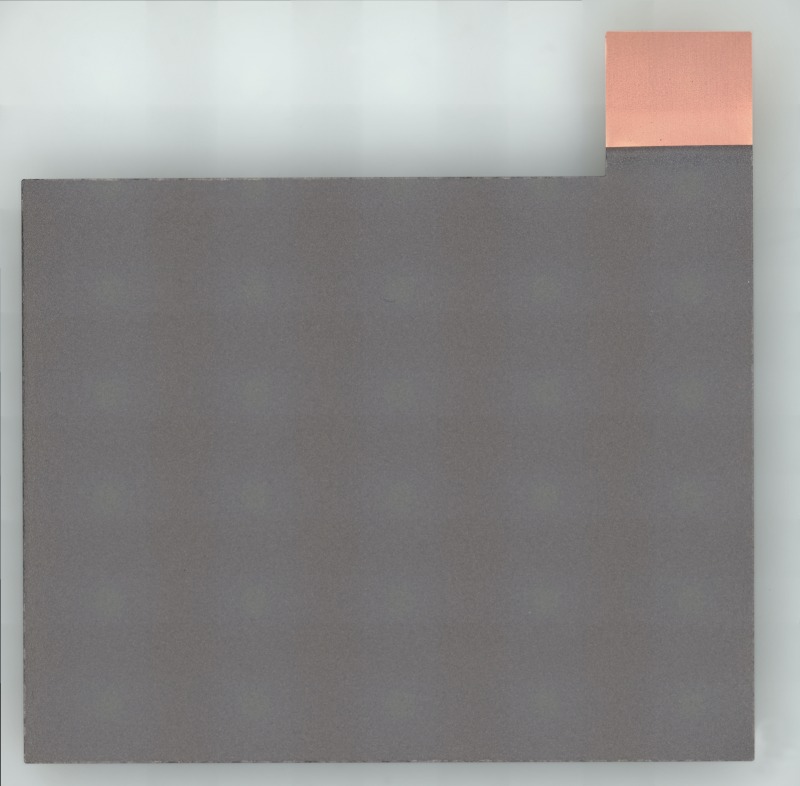
(Overall view of the electrode with the current collector tab)

(close-up of the uncoated area)
According to the customer, both the entire perimeter of the active material-coated area and the current collector tab, where the copper foil substrate is exposed, demonstrated excellent quality, far exceeding their initial expectations.
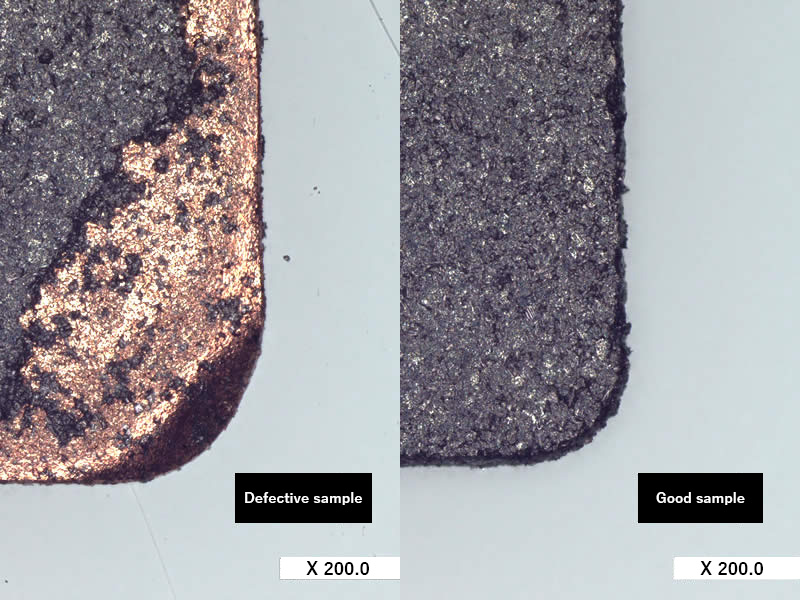 Cut-edge quality comparison at an electrode corner
Left: Steel rule die (Defective sample), Right: Punch-die tool (Good sample)
Dramatically improved operability
Providing excellent accessibility and usability, the Clean Press was highly rated for its ease of operation and processing speed, addressing another long-standing challenge. Its compact, lightweight design allows a single operator to easily move it in and out of a glove box and work comfortably even in confined glove box environments.
With the steel rule die previously used by the customer, each punched electrode had to be retrieved individually after every cutting operation. Sometimes, the cut electrode would stick to the blade and fail to release, and removing it with tweezers could result in damage or deformation.
With the adoption of the Clean Press, its precise shearing action and sharp cutting edges eliminated the problem of electrodes sticking to the blade.
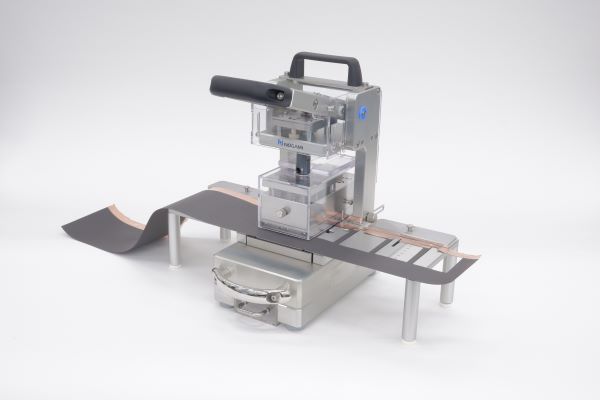
Punched electrodes automatically drop under their own weight into the collection container at the bottom of the Clean Press, enabling smooth, continuous processing. Simply insert the material through the open side, position and punch it, then feed it forward and repeat the process. (The 27 mm-deep collection container can hold up to 135 electrodes with a thickness of 200 μm each.)
Alternatively, removing the collection container enables hundreds of consecutive punching operations.
The simple, streamlined consecutive punching process eliminated handling errors while dramatically increasing processing speed.
The customer also praised the Clean Press for operator safety, commenting, “Whether during operation or when moving and setting up the jig, there is virtually no risk of anyone being injured by this tool.”
Customer feedback